
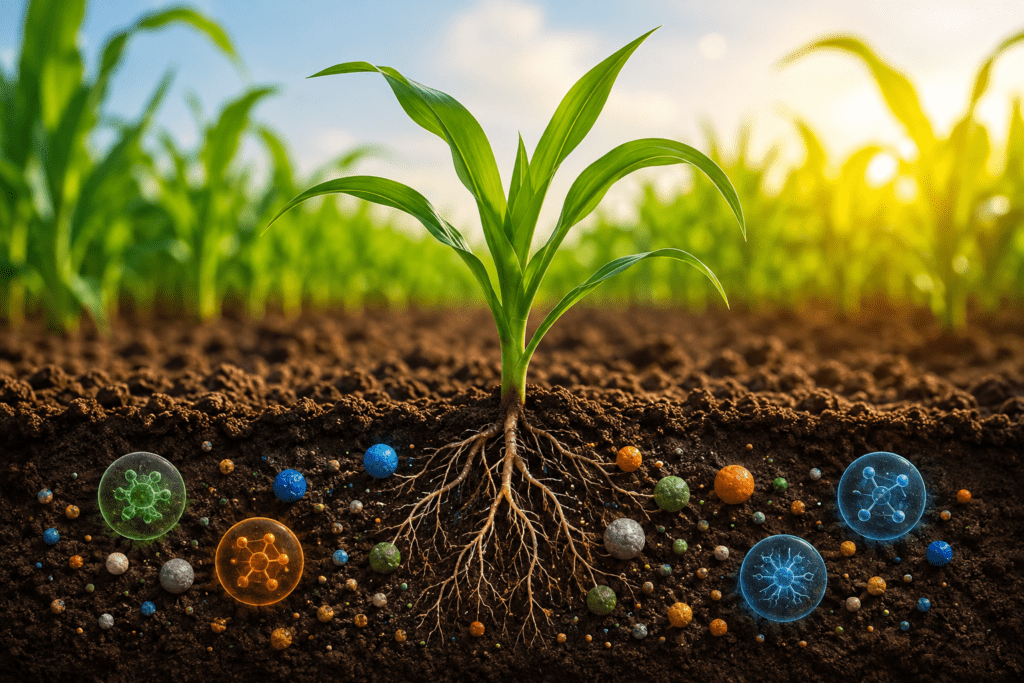
The Science of Balanced Crop Nutrition: Balanced NPK Nutrition and Micronutrients for Enhanced Soil Fertility
Modern agricultural systems face a persistent paradox: despite applying record quantities of chemical fertilizers, farmers worldwide frequently encounter stagnating crop yields, deteriorating soil quality, and declining nutrient use efficiency. The root cause of this challenge lies in a fundamental misunderstanding of plant nutrition – specifically, the over-reliance on primary macronutrients at the total neglect of secondary and micronutrients.
Achieving sustainable, high-yielding agriculture requires moving away from heavy, indiscriminate nitrogen application toward Balanced Fertilization. This practice delivers the exact ratio of primary macronutrients (Nitrogen, Phosphorus, Potassium), secondary macronutrients (Calcium, Magnesium, Sulfur), and essential trace micronutrients (Zinc, Iron, Boron, Manganese, Copper, Molybdenum, and Chlorine) that plants require at each physiological growth stage.
Liebig’s Law of the Minimum: The Core Principle of Balance
To understand balanced fertilization, one must first grasp Liebig’s Law of the Minimum, formulated by agricultural scientist Justus von Liebig in 1840. The law states that plant growth is dictated not by the total resources available, but by the scarcest resource (the limiting factor).
Imagine a wooden barrel constructed of staves of varying lengths, where each stave represents a specific nutrient. The water capacity of the barrel represents crop yield. If the stave for Zinc (Zn) or Boron (B) is short, the barrel can only hold water up to the height of that shortest stave – no matter how tall you build the Nitrogen (N) or Phosphorus (P) staves.
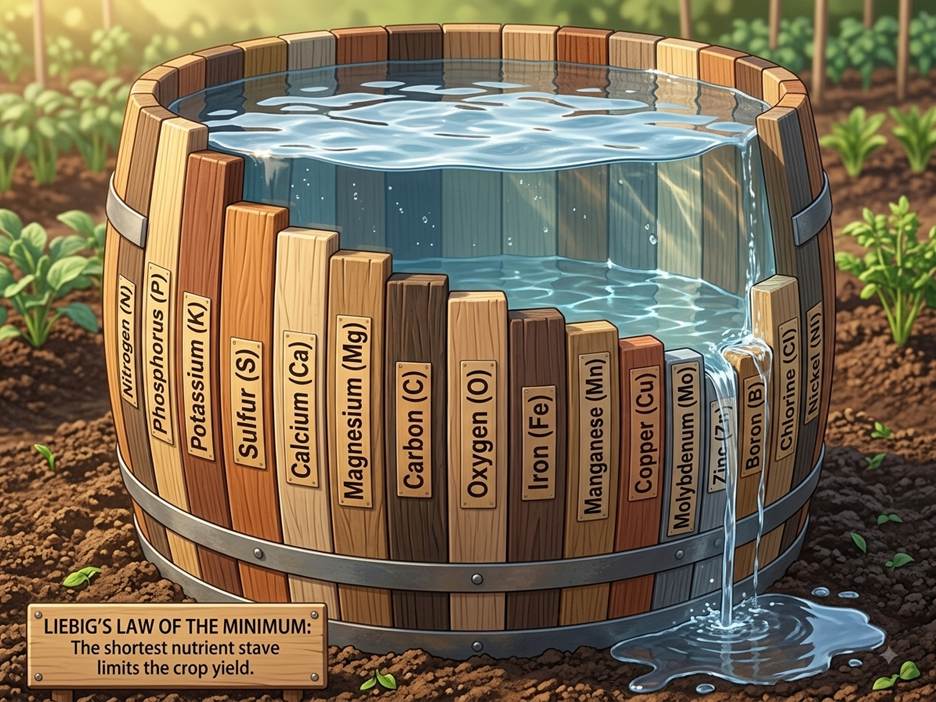
Dumping extra synthetic Urea onto a soil that is deficient in Zinc or Boron will yield zero additional grain; instead, it causes luxury consumption, pollutes groundwater, and acidifies the soil profile.
The Primary Trio: Decoding N, P, and K
Primary macronutrients are needed by plants in large quantities because they serve as the fundamental structural components of plant tissues and play critical roles in various physiological and biochemical processes.
1. Nitrogen (N): The Driver of Vegetative Growth
- Role: Nitrogen is the core constituent of amino acids, proteins, nucleic acids, and chlorophyll – the green pigment responsible for photosynthesis.
- Deficiency Signs: Older leaves turn pale yellow starting at the tips and progressing down the midrib (chlorosis), while overall growth becomes stunted.
- Toxicity Risks: Excessive nitrogen causes weak structural stems (lodging), delayed flowering, high susceptibility to insect pests, and nitrate leaching.
2. Phosphorus (P): The Energy Currency and Root Architect
- Role: Phosphorus is a vital component of adenosine triphosphate (ATP), nucleic acids, and phospholipids in cell membranes. It drives root development, early cell division, flowering, and seed maturation.
- Deficiency Signs: Dark green foliage that turns characteristic purplish-red along leaf margins, coupled with poor root establishment and delayed maturity.
- Fixation Challenges: Applied phosphorus easily reacts with calcium in alkaline soils or iron/aluminum in acidic soils, becoming locked in insoluble forms.
3. Potassium (K): The Master Regulator and Stress Buffer
- Role: Unlike N and P, potassium does not become part of plant structural compounds. Instead, it acts as an osmotic regulator, controlling stomatal opening and closing, water uptake, enzyme activation, and carbohydrate translocation.
- Deficiency Signs: Marginal leaf scorch – browning and dying (necrosis) along the outer edges of mature leaves, giving them a “burnt” appearance.
- Stress Management: Adequate potassium dramatically improves crop tolerance to drought, frost, and fungal diseases.
The Unsung Heroes: Essential Micronutrients
While primary nutrients form the biomass, micronutrients act as metabolic catalysts. Though required in tiny amounts (measured in parts per million, or ppm), their absence completely halts critical biochemical pathways.
1. Zinc (Zn)
- Function: Essential for tryptophan synthesis (a precursor to the plant growth hormone auxin), protein synthesis, and internode elongation.
- Deficiency: “Little leaf” disease, resetting of leaves, and severe interveinal chlorosis in young leaves (common in high-pH or over-phosphated soils).
2. Boron (B)
- Function: Controls cell wall structural integrity, pollen tube germination, flowering, fruit setting, and sugar translocation.
- Deficiency: Hollow heart in root crops, poor grain fill, bud necrosis, and brittle, distorted young leaves.
3. Iron (Fe) and Manganese (Mn)
- Function: Iron is required for chlorophyll synthesis and electron transfer systems, while Manganese drives water-splitting reactions during photosynthesis.
- Deficiency: Iron deficiency causes intense interveinal chlorosis on youngest leaves, turning them ivory-white. Manganese deficiency causes mottled chlorosis with necrotic specks.
4. Copper (Cu), Molybdenum (Mo), and Chlorine (Cl)
- Function: Molybdenum is a critical component of the nitrate reductase enzyme – without it, plants cannot utilize absorbed nitrogen. Copper aids lignin synthesis for stem strength, and Chlorine regulates cell turgor pressure.
The Dynamics of Nutrient Interactions
Applying nutrients in isolation ignores how minerals interact in the rhizosphere. Soil nutrients demonstrate complex synergistic (collaborative) and antagonistic (inhibitory) relationships:
- Phosphorus vs. Zinc Antagonism: Over-applying phosphatic fertilizers (such as DAP) inhibits root uptake of Zinc, triggering severe zinc deficiency symptoms even in soils with moderate zinc reserves.
- Potassium vs. Calcium/Magnesium: Excessive applications of muriate of potash (KCl) suppress plant absorption of Calcium (Ca^{2+}) and Magnesium (Mg^{2+}), leading to metabolic imbalances.
- Nitrogen-Potassium Synergy: Nitrogen uptake efficiency increases substantially when supported by optimal potassium levels, as K^+ acts as a counter-ion for nitrate (NO_3^-) translocation inside the plant.
Implementing the 4Rs of Balanced Stewardship
To maximize nutrient use efficiency (NUE) and protect soil health, modern agriculture relies on the 4R Nutrient Stewardship Framework:
- Right Source: Select fertilizer types that match soil pH and crop demands (e.g., using Chelated Micronutrients like Zn-EDTA in alkaline soils to prevent chemical fixation).
- Right Rate: Base fertilizer applications on quantitative soil testing and target yield goals rather than generalized regional recommendations.
- Right Time: Divide nitrogen applications among the vegetative, flowering, and grain-filling stages rather than applying all nitrogen at planting, ensuring better nutrient availability and reducing losses through leaching.
- Right Place: Place phosphorus and micronutrients in concentrated bands near the root zone rather than broadcasting them across the surface.
Comparative Matrix: Soil vs. Foliar Micronutrient Delivery
| Feature | Soil Application | Foliar Application |
| Best For | Preventive correction; basal application | Rapid correction of active visual deficiencies |
| Nutrient Forms | Granular sulfates, oxide powders | Water-soluble chelates (EDTA, DTPA), liquid concentrates |
| Fixation Risk | High in alkaline (pH > 7.5) or acidic (pH < 5.5) soils | Zero ground fixation; direct absorption through leaf stomata |
| Response Speed | Slow (requires root absorption and vascular movement) | Extremely rapid (visual recovery often seen in 48–72 hours) |
| Application Window | At land preparation or planting | During vegetative peaks, pre-flowering, or stress recovery |
Economic and Environmental Benefits of Balance
Transitioning to balanced fertilization delivers compounding long-term returns:
- Elevated Fertilizer Use Efficiency (FUE): Farmers can often decrease total bulk nitrogen inputs by 15-20% while increasing overall yield simply by correcting underlying Zinc or Boron deficits.
- Soil Ecosystem Regeneration: Balanced inputs preserve beneficial soil microflora and earthworm populations, maintaining biological nutrient recycling.
- Enhanced Crop Resilience: Plants receiving balanced NPK and trace minerals develop thicker cell walls, deeper root systems, and elevated phytonutrient compounds, making them naturally resistant to pest invasions and drought spells.
Balanced plant nutrition is not an added operational expense; it is a high-return investment in soil capital. By treating the soil as a living ecosystem requiring a full spectrum of mineral nutrition, farmers can achieve sustainable high yields while preserving arable land for future generations.