
The Underground Revolution: A Deep Dive into Green and Green Leaf Manuring
In the modern quest for sustainable agriculture, we often look toward high-tech solutions, yet some of the most powerful tools are as old as the soil itself. As synthetic fertilizer costs climb and soil health declines globally, farmers and gardeners are returning to a foundational practice: Manuring.
Specifically, Green Manuring and Green Leaf Manuring are the “secret weapons” of organic farming. They don’t just feed the plant; they build the “factory”—the soil—ensuring long-term fertility and resilience.
What is Green Manuring?
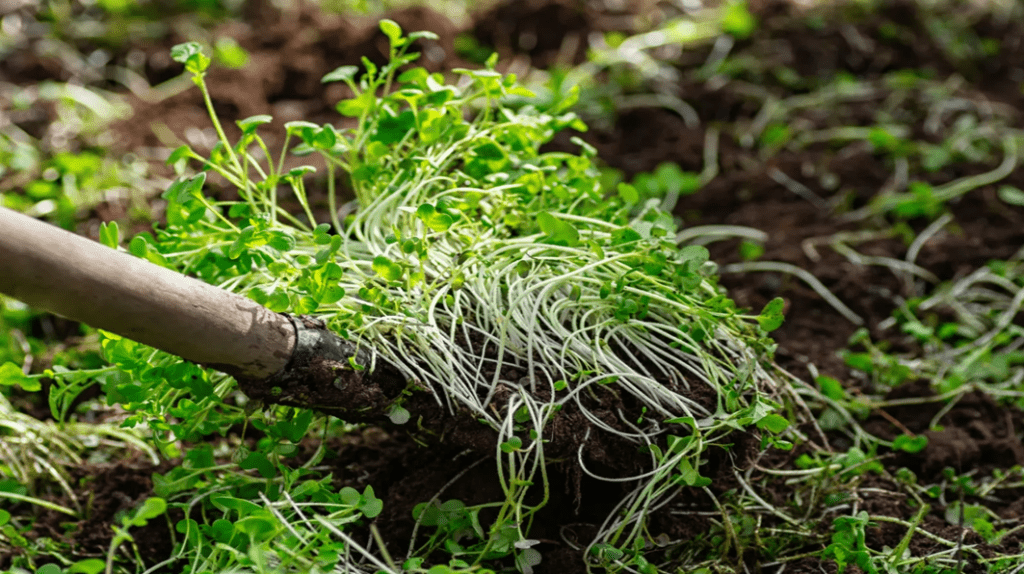
Green manuring is the practice of growing specific, often succulent crops and plowing them back into the soil while they are still green and tender. Instead of harvesting these crops for food or fodder, their entire biological “wealth” is sacrificed to enrich the land.
In general, leguminous plants are selected because of their rare ability to “fix” atmospheric nitrogen. Through a symbiotic relationship with Rhizobium bacteria in their root nodules, these plants convert nitrogen from the air into a form that subsequent crops can use.
Common Green Manure Crops:
- Sunnhemp (Crotalaria juncea): Fast-growing and excellent for nitrogen.
- Dhaincha (Sesbania aculeata): Highly tolerant of waterlogging and salinity.
- Cluster Bean (Guar): Ideal for arid and semi-arid regions.
- Pulses: like Cowpea, Horse gram, etc.
What is Green Leaf Manuring?
While it sounds similar, green leaf manuring differs in its logistics. It involves collecting green leaves, tender twigs, and herbaceous loppings from plants grown elsewhere—such as forest trees, wasteland shrubs, or field bunds—and incorporating them into the target field.
This method is particularly useful for farmers who cannot afford to leave their main field empty for a season to grow a dedicated green manure crop.
Elite Sources for Green Leaf Manuring:
When rainfall is the limiting factor, farmers should look toward hardy, drought-tolerant perennials that provide high-quality foliage:
- Gliricidia (Gliricidia sepium): Often called the “Quick Stick,” it is perhaps the best GLM plant. It can be grown on the borders of the field. It is drought-resistant and produces massive amounts of nitrogen-rich green leafy biomass multiple times a year.
- Pongamia (Pongamia pinnata): A hardy tree that thrives in poor soil. Its leaves are rich in nutrients and contain alkaloids that help manage soil-borne pests—a common issue in moisture-stressed soils.
- Adhatoda (Adhatoda vasica): A shrub often found in wastelands. Its leaves are brilliant for Green Leaf Manuring and are notable to have insecticidal & fungicidal properties.
- Cassia fistulua: A wild legume that grows in arid conditions and provides a high volume of biomass.
Green Manuring vs. Green Leaf Manuring: The Key Differences
Understanding the nuances between these two helps in choosing the right strategy for your land.
| Feature | Green Manuring | Green Leaf Manuring |
| Origin | Grown in-situ (on the same field). | Brought from outside (off-site). |
| Crop Type | Usually annual herbs/legumes. | Leaves from perennial trees/shrubs. |
| Labor | Lower labor for transport; requires plowing. | Higher labor for lopping and transport. |
| Time Investment | Occupies the field for 6–8 weeks. | Does not occupy the main field. |
| Impact on Soil Structure | High (roots penetrate and aerate soil). | Moderate (primarily adds surface organic matter). |
When is the Right Time to Grow Green Manure?
Timing is everything. If you plow too early, you lose biomass; if you plow too late, the plant becomes “woody,” taking longer to decompose and potentially locking up nitrogen.
1. The Growing Season
In most tropical climates, the pre-monsoon season is ideal. The early rains provide the moisture needed for rapid germination. This allows the crops to reach their peak biomass just before the main Kharif (monsoon) crop is sown.
2. The Turning-In Stage
The “Goldilocks” moment for plowing under a green manure crop is at the flowering stage. Why? At this point, the plant has maximum succulent biomass and the highest nitrogen content.
- The 50% Rule: Aim to incorporate the crop when about 50% of the field has started showing flowers.
Benefits of Green and Green Leaf Manuring:
The advantages of these practices go far beyond just “adding nitrogen.” It is a holistic renovation of the soil ecosystem.
1. Enhanced Soil Fertility
Green manures can add anywhere from 60 to 120 kg of Nitrogen per hectare. They also bring up nutrients like Phosphorus and Potassium from deeper soil layers via their root systems, making them available to shallow-rooted crops.
2. Improved Soil Structure
The organic matter acts as a “glue,” binding soil particles into aggregates. This improves water-holding capacity in sandy soils and aeration in heavy clay soils.
3. Weed Suppression
Fast-growing crops like Dhaincha create a dense canopy that smothers weeds, reducing the need for herbicides in the subsequent cropping cycle.
4. Microbe Stimulation
The sudden influx of fresh organic matter acts like a feast for soil microorganisms. This “microbial explosion” accelerates the nutrient cycle and helps suppress soil-borne pathogens.
Efficient Methods to Follow:
To get the most “bang for your buck,” follow these best practices for incorporation:
Step 1: Selection
Choose a crop based on your soil type. Use Dhaincha for alkaline or salty soils, and Sunnhemp for well-drained loamy soils.
Step 2: Sowing Density
Sow the seeds thickly. A higher seed rate ensures a dense canopy that prevents soil erosion and maximizes biomass.
Step 3: The Incorporation Process
- Knockdown: Use a plank or a roller to flatten the standing crop.
- Maceration: Use a disc harrow or a rotavator to chop the green matter into small pieces.
- Burial: Ensure the material is buried at a depth of 15 to 20 cm.
- Decomposition Gap: Allow 2 to 3 weeks for the material to decompose before sowing your main crop. This prevents “seedling injury” caused by the heat and gases produced during fermentation.
Conclusion:
Green manuring and green leaf manuring are not just “alternative” farming techniques; they are essential pillars of regenerative agriculture. By sacrificing one short season or utilizing the greenery around our borders, we can drastically reduce our dependence on chemical inputs and leave the soil better than we found it.
In an era of climate uncertainty, building “carbon-rich” soil is the best insurance policy a farmer can have.